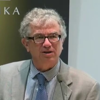
Jeffrey Frankel, a professor at Harvard University's Kennedy School of Government, previously served as a member of President Bill Clinton’s Council of Economic Advisers. He directs the Program in International Finance and Macroeconomics at the US National Bureau of Economic Research, where he is a member of the Business Cycle Dating Committee, the official US arbiter of recession and recovery.
Jeffrey Frankel is James W. Harpel Professor at Harvard University’s Kennedy School of Government. He directs the program in International Finance and Macroeconomics at the National Bureau of Economic Research, where he is also on the Business Cycle Dating Committee, which officially declares U.S. recessions. Professor Frankel served at the U.S. President’s Council of Economic Advisers twice: on the staff (1983-84) and as a Member (under President Clinton, 1996-99). His responsibilities as Member included macroeconomics, international economics, and the environment.
Before moving east, he had been Professor of Economics at the University of California, Berkeley, having joined the faculty in 1979. He is on advisory panels for the Federal Reserve Banks of New York and Boston, the Bureau of Economic Analysis, and the Peterson Institute for International Economics. He is a member of the Bellagio Group and the Council on Foreign Relations, and co-chairs the annual International Seminar on Macroeconomics. In the past Jeff Frankel has often visited the Peterson Institute for International Economics, the International Monetary Fund and the Federal Reserve Board.
His research interests include currencies, crises, commodities, trade, international finance, monetary policy, fiscal policy, the natural resource curse, and global environmental issues. His most cited article is “Does Trade Cause Growth?” (AER, 1999). Recent papers include "Over-optimism in Forecasts by Official Budget Agencies and Its Implications (OREP, 2011) and “Are Leading Indicators Useful for Assessing Country Vulnerability? Evidence from the 2008-09 Global Financial Crisis” (J.Int.Ec., 2012). He writes a blog and a textbook. He was born in San Francisco, graduated from Swarthmore College, and received his Economics PhD from MIT.
Fear of Fracking
Sean Mac: The author concludes that "No other factor [but fracking] comes close to providing a plausible explanation" of the drop of emissions of carbon dioxide. Really? How unscientific above statement is! T…
Fear of Fracking
Justin Pearce: I'm not in favour or against fracking in principle, but the risks of methane leakage during the process may result in a net increase in global warming potential even compared to the dirtiest coal. Thi…