Euronomics
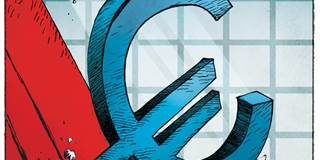
The Decline and Fall of the Euro?
Daniel Gros
|
|
|
|
BRUSSELS – Great empires rarely succumb to outside attacks. But they often crumble under the weight of internal dissent. This vulnerability seems to apply to the eurozone as well.
Key macroeconomic indicators do not suggest any problem for the eurozone as a whole. On the contrary, it has a balanced current account, which means that it has enough resources to solve its own public-finance problems. In this respect, the eurozone compares favorably with other large currency areas, such as the United States or, closer to home, the United Kingdom, which run external deficits and thus depend on continuing inflows of capital.
In terms of fiscal policy, too, the eurozone average is comparatively strong. It has a much lower fiscal deficit than the US (4% of GDP for the eurozone, compared to almost 10% for the US).

Debasement of the currency is another sign of weakness that often precedes decline and breakup. But, again, this is not the case for the eurozone, where the inflation rate remains low – and below that of the US and the UK. Moreover, there is no significant danger of an increase, as wage demands remain depressed and the European Central Bank will face little pressure to finance deficits, which are low and projected to disappear over the next few years. Refinancing government debt is not inflationary, as it creates no new purchasing power. The ECB is merely a “central counterparty” between risk-averse German savers and the Italian government.
Much has been written about Europe’s sluggish growth, but the record is actually not so bad. Over the last decade, per capita growth in the US and the eurozone has been almost exactly the same.
Given this relative strength in the eurozone’s fundamentals, it is far too early to write off the euro. But the crisis has been going from bad to worse, as Europe’s policymakers seem boundlessly capable of making a mess out of the situation.
The problem is the internal distribution of savings and financial investments: although the eurozone has enough savings to finance all of the deficits, some countries struggle, because savings no longer flow across borders. There is an excess of savings north of the Alps, but northern European savers do not want to finance southern countries like Italy, Spain, and Greece.
That is why the risk premia on Italian and other southern European debt remain at 450-500 basis points, and why, at the same time, the German government can issue short-term securities at essentially zero rates. The reluctance of Northern European savers to invest in the euro periphery is the root of the problem.
So, how will northern Europe’s “investors’ strike” end?
The German position seems to be that financial markets will finance Italy at acceptable rates if and when its policies are credible. If Italy’s borrowing costs remain stubbornly high, the only solution is to try harder.
The Italian position could be characterized as follows: “We are trying as hard as humanly possible to eliminate our deficit, but we have a debt-rollover problem.”
The German government could, of course, take care of the problem if it were willing to guarantee all Italian, Spanish, and other debt. But it is understandably reluctant to take such an enormous risk – even though it is, of course, taking a big risk by not guaranteeing southern European governments’ debt.
The ECB could solve the problem by acting as buyer of last resort for all of the debt shunned by financial markets. But it, too, is understandably reluctant to assume the risk – and it is this standoff that has unnerved markets and endangered the euro’s viability.
Managing a debt overhang has always been one of the toughest challenges for policymakers. In antiquity, the conflicts between creditors and debtors often turned violent, as the alternative to debt relief was slavery. In today’s Europe, the conflict between creditors and debtors takes a more civilized form, seen only in European Council resolutions and internal ECB discussions.
But it remains an unresolved conflict. If the euro fails as a result, it will not be because no solution was possible, but because policymakers would not do what was necessary.
The euro’s long-run survival requires the correct mix of adjustment by debtors, debt forgiveness where this is not enough, and bridge financing to convince nervous financial markets that the debtors will have the time needed for adjustment to work. The resources are there. Europe needs the political will to mobilize them.
Daniel Gros is Director of the Center for European Policy Studies.
Copyright: Project Syndicate, 2012.
www.project-syndicate.org
You might also like to read more from Daniel Gros or return to our home page.
|
|
Zsolt 09:05 03 Jan 12
Although factually the article states important points, unfortunately it is missing the most important ones.
Yes, from the outside eveything looks relatively healthy, especially comparing the Eurozone to other parts of the world economy.
But if we look at a very sick person from the outside, sometimes we do not notice any problems but when going into details we see how abnormal things are.
The greatest problem in the Eurozone first of all is that the southern nations, which were very useful as they are before, with their large markets and love of life and spending, taking loans to consume all the products the northern nations dumped on them, suddenly became the enemy when the system is falling apart bacuse of the global crisis, and now suddenly everybody expects the Italians, Spanish and Greek to behave and live like Germans or Scandinavians from one moment to the other.
It is like in our body suddenly we think the foot is not useful as a foot anymore so we require it to function like another organ, become like wings so we could fly.
Moreover even if all the austerity measures worked, in a failing global economy there is no hope that someone can simply just jumps ahead, flip into increasing growth again, when the other parts of the integral, interdependent network are still struggling.
So for any solution we cannot view Europe as an isolated incident outside of the global economy, for any change to occur we need a global, overall solution first.
Besides we cannot expect countries or individuals suddenly to change character, but we have to build such a system where the strength and weaknesses of each individual and nation can be catered for, can be balanced out, so each nation and individual can maximally use and utilize their own capablities for the benefit of the whole system, only in such a mutually considerate and cooperating global network can we build a sustainable future.
klauskastner 09:57 03 Jan 12
One should never forget what turned external payment problems of individual countries into the European debt problem of today: the EU fell for the arguments of the financial sector that government bonds should be risk-free because otherwise bond markets would collapse. As a result, the EU declared the Greek problem from the start as an issue for the existence of the Euro, the Eurozone and, for that matter, the entire EU. Below are alternative courses of action which should have been taken (and which might still be available alternatives).
http://klauskastner.blogspot.com/2011/12/closing-2011-with-minority-view.html
http://klauskastner.blogspot.com/2011/12/since-all-current-rescue-efforts-are.html
myerscpa 12:16 05 Jan 12
A single-currency union requires a strong system-wide banking system to provide credibility to financial obligations. So political integration may not be a necessity, just political institutions strong enough to create a strong European-wide banking system. At least for now.
At this juncture, a srong banking system requires lots of government-provided capital. Then over time the banks need to be recapitalized with private capital to have the ability to make market-based credit judgments and not politically guided credit decisions (the French will have great difficulty with this).
So getting to "there" from "here" may be a little easier than many pessimists think.
Paul A. Myers
RedBaker 05:02 08 Jan 12
The problem is massive, unsustainable debt and interest payments. The EU is a business partnership of some good partners and some very bad ones.The good partners must decide to cut bait or be dragged down by the slackers.
The politicians are trying to save the EU, not save their own nations' economies. Their ultimate goal is consolidation of Europe under a single massive socialist bureaucratic government, not the economic health of their own nations.
This is what socialism creates - welfare dependency, rent seeking business, ever-growing government, increasing debt, slow growth and high unemployment. It punishes success and rewards failure in order to buy votes. They have now run out of other people's money. It it were a corporation it would declare bankruptcy and start over.
gamesmith94134 08:20 08 Jan 12
Gamesmith94134: Islamic Finance unbound
IMF would urge BRIC and emerging nations set up funds for the settle the near crisis, and some would suggest the write-off for those debts; but how could one give away money for uncertainty? At present, I would propose a “Seven Percent Solution” which will balance the low interest payment and build up the assets for the sovereignty debtors in the 3% coupon for tax and 3% equity build up through investment; plus 1% insurer fee for the global observers who runs its development and collect repayment. For example:
would you put your asset in the 10 million Euro worth of bonds in full to the World Bank which garantees a 3% annum in coupon? The coupon to you is tradable in open market to your exporters, and serves for tax credit to your nominated soveriegnty nation like Greece, and the 10 million Euro worth of bonds is withheld a parcel which the World Bank will guarantee Greece will return in full parcel in nominated currency or equity applied. Since the parcel may not adequately applied with equity or privatized assets, such parcel will come through arbitration by World Bank to ensure Greece will comply with integrity for its liabilities. Thereon, the quarterly payments of 4% will come from Greece that 1% no- refunable applies to the services and reserves to World Bank; and 3% will subsidize privatized programs would be used as collerateral, under the scrutiny of the global observers. The funding of these installments are used to promote growth within Greece in order to create its foundation in the tax system to make it affective in the fiscal processing and politicians. What if Greece default again on its installments of the loan or the loan? The 3% of investment in the privatised programs will goes to China, and the parcel can settle on the prerformance after arbitration.
It sounds naieve to accept such “Seven Percent Solution” when inflation rate is way higher than 7% in China, but what if Euro or its currency dropped over 7%. However, it is more important that the stand-off in the liabilities in both sides, then, rebalancing both the exchange rates or economies could make the situation worsen; then, not even the 3% is garanteed. If the slowdown of EU or US is contagious to the system, I doubt China can run on its 8% growth in the next year; but, the funding to the 7% coupon can stop Euro going with a run-off to 1.4 to 1.8 or RMB 4.5 to a dollar; or 15% write-off is demanded by the banking of China after default.
“As a matter of fact, reward in the Hereafter (AAKHIRAT) should have been the main purpose of Islamisation. It might not have attracted many people, but the foundation would have been firm.” Islamic financing arrangements used in Islamic banking
(MUSHARIKA, MURABIHA, QARDE AL'HASANA, IJAREH, MUDARABA)
Author: EHSAN ZARROKH 2007-04-06
I pondered how the Islamic finance can help if usury is not acceptable under the Sharia’h. If the IJARAH with 3% withheld by the World Bank, as insurers ‘tankaful’ using 1% in financing and supervising developments in "USUFRUKT", the privatized investment through agribusiness, or for the exchange of the coupon in deferred tax; then this Seven Percent solution can help to release the tension on the rollover sovereignty debts, and the debtor nation may not have to suffer further austerity program in shrinking its economy and restraining its growth. Some fantasy—but I like Islamic finance better than hoarding the currencies more for growth.
May the Buddha bless you?
gamesmith94134 08:22 08 Jan 12
Gamesmith94134: global finance’s Supply-chain Revolution
“Open feedback mechanisms ensure a supply chain’s ability to respond to a changing environment, but, in the case of financial supply chains, feedback mechanisms can amplify shocks until the whole system blows up.” It was because there is no firewall available during the crisis, and the pipeline was open with few operators in the financial control like Mr. Sheng said, also, there is even fewer currencies like Euro-dollar only was available in most transactions, even though the public funds like sovereignty debts were being privatized in the open trade, and it create the explosion by volume in sum of money was credited. Firewalls I took off the technical terminology means there is no safety transitory zone established physically, that our financial system allowed the flow in the supply chain freely as the computerized transaction allowed, and there is less time available for reexamination on lack of control, source of origin, birth of credits.
Especially, when the parties took the international reserves for granted that Fed and ECB cut it interest rates to its minimal for the non-inflationary measure that many would consider money are free if they can beat the time. Generally, the 22 players turned the international financial market into their casino. When their governments were the ones who called to upbeat its economies from the recession after the expansion of the debts hitting it fiscal ceiling, and the slow down cut their productivity in near recession. At the same time, the rigid exchange rate went lopsided that created the tension between the debtor and creditor. It exploded.
At present, the financial system must evolve itself with firewalls that stop contagion of the collateral damage over the money with no backing, and shrink the pool of cash for credit lending. Some might call it deleverage of the past 20 years mishaps, or change of climate in our global financial that the supply-chain must stop and check itself; besides, most of us would know by now that money supply and productivity are not on the same parallel at certain point under the influence of inflation an deflation. Without the assurance of the balance payment or imbalance of its exchange rates, the supply-chain will reverse itself.
Perhaps, I like it better if the sovereignty debt and private investment should not be classified as same in enjoying the low interest rate, that sovereignty debt should be handled separately by the Central Banks and World Bank if it does affect the exchange rate when evaluated by IMF for it answer to lack of control.
Transfer Unions must be established to void unsafe transaction and the Trans-continental Zoning to confirm the source of the origin on all transactions when the transaction is registered to enter its zones, or cut hot cashes that undervaluing ones currency from another that influences the international currency exchange rate. Besides, I see the floating rate system is a joke if it put sovereignty in defensive; and it should go with its yardstick like performance that values at each quarters.
Finally, international banks are “too big to fall” should became a legend only, and they must be downsized that international is not licensed to evade sovereignty. There are more of reforms available in regional account and obey to safety net where it allows. Perhaps, if the banker can purchase these sovereignty bonds and metro bonds from the central bank like FED or ECB instead of chasing the wild goose in the open market; the general public can have some credits available for doing business.
If someone question on the equities dealing among the banks, why only the politicians who talk over the policy on financial and there is no financial police system to oversight the banking as a whole. I think the United Nations Security Council can build a better division on financial security than G7 or G20, and it is inclusive for the globalized finance and my past experience tells me so. Evolve or not, we may stand by and watch the outcome of our present crisis and it not over yet till everyone would feel safe from hegemony through these firewalls. If some suggest cooperation from community in forgiving ones’ debt, it would be worse than my New Year project in losing weight every year, and I have been laughing at myself all my life. Without firewall in safeguard one’s wealth, each would isolate itself from contagion for a long, long time.
May the Buddha bless you?


Pascal 05:55 03 Jan 12
"The euro’s long-run survival requires the correct mix of adjustment by debtors, debt forgiveness where this is not enough, and bridge financing to convince nervous financial markets that the debtors will have the time needed for adjustment to work. The resources are there. Europe needs the political will to mobilize them."
Unfortunately, you have touched upon a simplistic solution to a simplistically laid out problem. This type of exposition is misleading at best.
The problems with the Euro are far deeper, and many more thoughtful economists pointed them out before its imposition on the citizens of the original 15 countries by 'glory-seeking' politicians (e.g. Mitterand, Delors, a host of European Commission types, etc.). Essentially, the economic sequence of events that would have given the Euro a solid foundation was turned on its head.
As long as a single currency is imposed upon a collection of disparate economic entities with 1) no homogenous (not necessarily centralized) fiscal/economic/'social' legal and taxation system, 2) no real single and independent central bank with a broad mandate, and 3) true democratic authority exercised by the citizens, the chances of it actually working are pretty close to nil.
The financial markets (i.e. the investing/capital-providing world) has understood this and has reached the end of its patience with simplistic, short-term solutions. I would offer that you should return to your copy and think through it again.