America’s Blinders
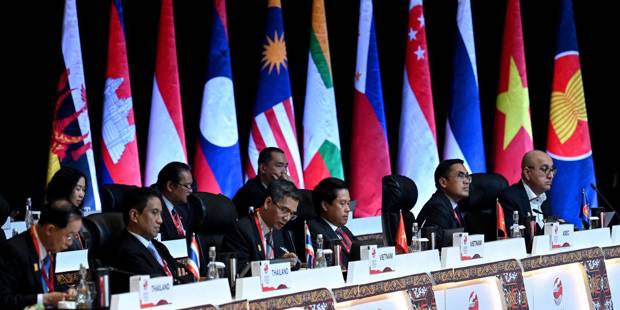
Jean-Pierre Lehmann has, unsurprisingly, offered a brilliant response to my commentary. He agrees that “the West” is in relative decline, and poses the key question, “what Asia?” Isn’t Asia simply a term that Europeans use to describe “not the West,” leaving the concept of being “Asian” devoid of internal unity or coherence?
Lehmann may well be right. But personal experience has taught me that an Asian identity does exist. People living in different corners of Asia do feel some sense of cultural or emotional connection. Although I have never felt a cultural connection when traveling to Africa, Latin America, Europe, or North America, I have felt it in most areas of Asia, even across sharp religious and ethnic divides.
I was born a Hindu Sindhi in Singapore, after my Hindu parents’ traumatic escape from a bitter Hindu-Muslim conflict in Pakistan, where millions were killed. Consequently, as a child, I ascribed a lot of antipathy to the Islamic world.
As a young man, I was shocked to discover that my name, “Mahbubani,” has Arabic/Persian roots (it is derived from the word mahboob, meaning “beloved”), and to realize that the Sindhi script that I used as a child was the Arabic script. When I travelled to Tehran for the first time, I found connections in culture and cuisine. Our cultural DNA clearly had common elements.
As an ethnic Indian, I obviously have deep cultural connections throughout South Asia. What is surprising is that I feel a similar connection throughout Southeast Asia. Nine out of ten ASEAN member states have an ancient Indian cultural bedrock. This explains why the Ramayana is also part of the traditional mythology of Indonesia and Thailand. The Islamic overlay added another level of cultural connection.
Northeast Asia might seem culturally remote from my Indian origins. But when I travel to China, Japan, or Korea, I feel an immediate cultural connection with the Buddhist streams in their societies, because, when I was a child, my mother would take me to both Hindu and Buddhist temples to pray. I was not surprised in 2000, when the young, modern South Korean woman I met in Kolkata airport told me that she had decided to visit India to connect with her Buddhist heritage. She is undoubtedly among the first of many more pilgrims to travel from Northeast Asia to India.
As I grow older, I increasingly recognize that the 200 years of European colonial domination did “chop up” Asia, creating artificial boundaries that destroyed old patterns of cultural connectivity. As Western influence recedes, the old “natural” pattern of Asian cultural connectivity will resume.
One bellwether project to watch is the effort – spearheaded by Amartya Sen and Singapore’s former foreign minister, George Yeo – to revive Nalanda University. If East, South, and Southeast Asia can cooperate to revive what was the world’s greatest university from 500 to 1200 AD, where the legendary Chinese monk Xuanzang spent two years, we might see the revival of old patterns of Asian connectivity. The world will then come to discover that Asia’s identity may be far more complex than just “not Europe.”