According to conventional wisdom, we are voraciously using the world’s resources and living way beyond Earth’s means – a narrative of decline and pessimism that underlies much of today’s environmental discourse. But this received wisdom is fundamentally wrong.
COPENHAGEN – According to conventional wisdom, we are voraciously using the world’s resources and living way beyond Earth’s means. This narrative of decline and pessimism underlies much of today’s environmental discourse, and is often formulated in a simple fashion: by 2030, we will need two planets to sustain us, owing to higher living standards and population growth. If everyone managed to live at American living standards today, we would need almost five planets. But this received wisdom is fundamentally wrong.
Environmental campaigners use the so-called “ecological footprint” – how much area each one of us requires from the planet – to make their point. We obviously use cropland, grazing land, forests, and fishing grounds to produce our food, fiber, and timber, and we need space for our houses, roads, and cities. Moreover, we require areas to absorb the waste emitted by our energy use. Translating all these demands into a common unit of physical area gives us an opportunity to compare it with Earth’s productive area – and thus to get a sense of how sustainable we are.
For more than a decade, the World Wildlife Fund and several other conservation organizations have performed complicated calculations to determine individual “footprints” on the planet. Their numbers show that each American uses 9.4 hectares of the globe, each European 4.7 hectares, and those in low-income countries just one hectare. Adding it all up, we collectively use 17.5 billion hectares.
Unfortunately, there are only 13.4 billion hectares available. So the WWF points out that we are already living beyond Earth’s means, using around 30% too much. And it will get worse. They tell us that the recent financial crisis “pales in comparison to the looming ecological credit crunch,” which could presage “a large-scale ecosystem collapse.”
This message is being seared it into the public consciousness. The British newspaper The Observer used the headline “Wanted: New Earth by 2050”; according to the BBC, Earth is “on course for eco-crunch”; and The Washington Post was horrified by the four extra planets needed, and urged us to use more canvass shopping bags and energy-saving light bulbs.
The message has been received loud and clear. We are using up too much of the planet’s area. But wait a minute. How can we do that? How can we actually use more area than there is on earth?
Access every new PS commentary, our entire On Point suite of subscriber-exclusive content – including Longer Reads, Insider Interviews, Big Picture/Big Question, and Say More – and the full PS archive.
Subscribe Now
Obviously, any measure that tries to aggregate many different aspects of human behavior will have to simplify the inputs; the ecological footprint is no different. For example, when we talk about American lifestyles needing five planets, we assume that technology is frozen, whereas it is likely that worldwide land-use productivity will increase dramatically. Likewise, organic farming actually leaves a larger footprint than its conventional cousin.
Yet, despite such shortcomings, it is clear that areas we use for roads cannot be used for growing food, and that areas we use to build our houses takes away from forests. This part of the ecological footprint is a convenient measure of our literal footprint on earth. Here, we live far inside the available area, using some 60% of the world’s available space, and this proportion is likely to drop , because the rate at which the earth’s population is increasing is now slowing, while technological progress continues. So no ecological collapse here.
There is just one factor that keeps increasing: our carbon emissions. It is not at all obvious to anybody how to convert CO2 to area. The WWF and some researchers choose to get around this by defining the area of emissions as the area of forest needed to soak up the extra CO2. This now makes up more than 50% of the ecological footprint, and will grow to three-quarters before mid-century.
In essence, we are being told that we ought to cut emissions to zero, and to plant trees to achieve that, meaning that we would have to plant forests today on 30% more than all of the available land, and plant forests on almost two planets by 2030. This is unreasonable.
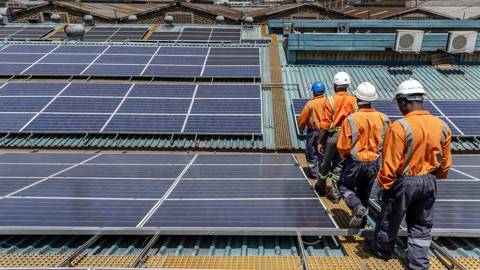
Is it really necessary for us to cut all emissions? Just cutting about half of all emissions would reduce greenhouse gas concentrations in the medium term. More importantly, planting forests is one of the least area-efficient low-tech ways to cut carbon. Solar cells and wind turbines require less than 1% of the area of forests to reduce CO2, they become increasingly efficient, and they can often be placed on non-productive land (such as wind turbines at sea and solar panels in deserts). Measured this way, the scary eco-crunch disappears.
Due to technology, the individual demand on the planet has already dropped 35% over the past half-century, and the collective requirement will reach its upper limit before 2020 way below any overdraft.
Translating CO2 into an illogical and inefficient measure of forest cover seems intended mainly to ensure that an alarming message results. In the scientific literature, a leading modeler acknowledges that most modelers regard this method as “hard to defend.” Two other research teams have pointed out that the ecological footprint “itself is nothing more than an important attention-grabbing device,” and that “it is less a scientific measure than one designed to raise public awareness and influence politics.”
When we really examine the “ecological footprint” calculations, we discover that the only thing the world is running out of is space to plant a colossal amount of imaginary forest that we wouldn’t have planted anyway, to avoid CO2 emissions that we can prevent through much smarter and cheaper means.
That our profligate consumption requires five planets is a catchy story, but it is wrong. The planet we have is more than enough.
To have unlimited access to our content including in-depth commentaries, book reviews, exclusive interviews, PS OnPoint and PS The Big Picture, please subscribe
Many countries’ recent experiences show that boosting manufacturing employment is like chasing a fast-receding target. Automation and skill-biased technology have made it extremely unlikely that manufacturing can be the labor-absorbing activity it once was, which means that the future of “good jobs” must be created in services.
shows why policies to boost employment in the twenty-first century ultimately must focus on services.
Minxin Pei
doubts China’s government is willing to do what is needed to restore growth, describes the low-tech approaches taken by the country’s vast security apparatus, considers the Chinese social-credit system’s repressive potential, and more.
For the last several years, world leaders have made big promises and laid out bold plans to mitigate the climate crisis and help the neediest countries adapt. At this year's World Bank/IMF Spring Meetings, they must demonstrate that they can fulfill these promises, rather than simply touting new ones.
think policymakers need to get four things right to shore up the credibility of the international system.
Log in/Register
Please log in or register to continue. Registration is free and requires only your email address.





COPENHAGEN – According to conventional wisdom, we are voraciously using the world’s resources and living way beyond Earth’s means. This narrative of decline and pessimism underlies much of today’s environmental discourse, and is often formulated in a simple fashion: by 2030, we will need two planets to sustain us, owing to higher living standards and population growth. If everyone managed to live at American living standards today, we would need almost five planets. But this received wisdom is fundamentally wrong.
Environmental campaigners use the so-called “ecological footprint” – how much area each one of us requires from the planet – to make their point. We obviously use cropland, grazing land, forests, and fishing grounds to produce our food, fiber, and timber, and we need space for our houses, roads, and cities. Moreover, we require areas to absorb the waste emitted by our energy use. Translating all these demands into a common unit of physical area gives us an opportunity to compare it with Earth’s productive area – and thus to get a sense of how sustainable we are.
For more than a decade, the World Wildlife Fund and several other conservation organizations have performed complicated calculations to determine individual “footprints” on the planet. Their numbers show that each American uses 9.4 hectares of the globe, each European 4.7 hectares, and those in low-income countries just one hectare. Adding it all up, we collectively use 17.5 billion hectares.
Unfortunately, there are only 13.4 billion hectares available. So the WWF points out that we are already living beyond Earth’s means, using around 30% too much. And it will get worse. They tell us that the recent financial crisis “pales in comparison to the looming ecological credit crunch,” which could presage “a large-scale ecosystem collapse.”
This message is being seared it into the public consciousness. The British newspaper The Observer used the headline “Wanted: New Earth by 2050”; according to the BBC, Earth is “on course for eco-crunch”; and The Washington Post was horrified by the four extra planets needed, and urged us to use more canvass shopping bags and energy-saving light bulbs.
The message has been received loud and clear. We are using up too much of the planet’s area. But wait a minute. How can we do that? How can we actually use more area than there is on earth?
Subscribe to PS Digital
Access every new PS commentary, our entire On Point suite of subscriber-exclusive content – including Longer Reads, Insider Interviews, Big Picture/Big Question, and Say More – and the full PS archive.
Subscribe Now
Obviously, any measure that tries to aggregate many different aspects of human behavior will have to simplify the inputs; the ecological footprint is no different. For example, when we talk about American lifestyles needing five planets, we assume that technology is frozen, whereas it is likely that worldwide land-use productivity will increase dramatically. Likewise, organic farming actually leaves a larger footprint than its conventional cousin.
Yet, despite such shortcomings, it is clear that areas we use for roads cannot be used for growing food, and that areas we use to build our houses takes away from forests. This part of the ecological footprint is a convenient measure of our literal footprint on earth. Here, we live far inside the available area, using some 60% of the world’s available space, and this proportion is likely to drop , because the rate at which the earth’s population is increasing is now slowing, while technological progress continues. So no ecological collapse here.
There is just one factor that keeps increasing: our carbon emissions. It is not at all obvious to anybody how to convert CO2 to area. The WWF and some researchers choose to get around this by defining the area of emissions as the area of forest needed to soak up the extra CO2. This now makes up more than 50% of the ecological footprint, and will grow to three-quarters before mid-century.
In essence, we are being told that we ought to cut emissions to zero, and to plant trees to achieve that, meaning that we would have to plant forests today on 30% more than all of the available land, and plant forests on almost two planets by 2030. This is unreasonable.
Is it really necessary for us to cut all emissions? Just cutting about half of all emissions would reduce greenhouse gas concentrations in the medium term. More importantly, planting forests is one of the least area-efficient low-tech ways to cut carbon. Solar cells and wind turbines require less than 1% of the area of forests to reduce CO2, they become increasingly efficient, and they can often be placed on non-productive land (such as wind turbines at sea and solar panels in deserts). Measured this way, the scary eco-crunch disappears.
Due to technology, the individual demand on the planet has already dropped 35% over the past half-century, and the collective requirement will reach its upper limit before 2020 way below any overdraft.
Translating CO2 into an illogical and inefficient measure of forest cover seems intended mainly to ensure that an alarming message results. In the scientific literature, a leading modeler acknowledges that most modelers regard this method as “hard to defend.” Two other research teams have pointed out that the ecological footprint “itself is nothing more than an important attention-grabbing device,” and that “it is less a scientific measure than one designed to raise public awareness and influence politics.”
When we really examine the “ecological footprint” calculations, we discover that the only thing the world is running out of is space to plant a colossal amount of imaginary forest that we wouldn’t have planted anyway, to avoid CO2 emissions that we can prevent through much smarter and cheaper means.
That our profligate consumption requires five planets is a catchy story, but it is wrong. The planet we have is more than enough.